
Engineering is one of the most popular career choices among science students in Bangladesh. Every year, thousands of students prepare for engineering admission tests with the dream of studying subjects such as Computer Science and Engineering, Electrical and Electronic Engineering, Mechanical Engineering, Civil Engineering, Architecture, and other technical disciplines.
However, engineering admission preparation is not simply about studying for long hours. Students need a clear strategy, strong fundamentals, regular practice, effective time management, and the ability to solve problems quickly and accurately.
For many students, the biggest challenge is deciding what to study, how to study, which subjects to prioritize, and how to prepare for the admission test while maintaining their HSC academic performance.
This guide explains a practical engineering admission preparation strategy for Bangladeshi students. It covers subject preparation, question-solving techniques, revision methods, mock tests, common mistakes, and useful habits that can make preparation more organized.
What Is Engineering Admission Preparation?

Engineering admission preparation is the process of building the academic knowledge and problem-solving ability required for engineering university admission tests.
For science students, the core preparation usually involves subjects such as:
- Mathematics
- Physics
- Chemistry
- English
The exact subjects, marks distribution, question format, eligibility requirements, and admission process vary between institutions. Therefore, students should always check the official admission notice of the university they plan to apply to.
A good preparation strategy should combine textbook learning, concept building, problem solving, previous questions, revision, and mock examinations.
Why Is Engineering Admission Preparation Difficult?
Engineering admission tests can be competitive because many students apply for a limited number of seats.
Another challenge is that admission questions often require more than memorization. A student may understand a chapter but still struggle to solve a problem within a short time.
Three abilities are particularly important:
1. Conceptual Understanding
You need to understand why a formula or method works rather than simply memorizing it.
2. Problem-Solving Ability
You should be able to apply your knowledge to unfamiliar questions.
3. Time Management
Even when you know the answer, spending too much time on one question can reduce your overall score.
This is why engineering admission preparation should focus on quality of practice rather than simply counting study hours.
Start With Your HSC Academic Preparation

One of the biggest mistakes students make is treating HSC preparation and admission preparation as completely separate tasks.
A strong HSC foundation can make later admission preparation much easier.
During your HSC study period, concentrate on understanding the core concepts of Physics, Chemistry and Mathematics.
Instead of asking:
“How many chapters can I finish today?”
ask:
“How well do I understand this chapter?”
A chapter that you understand deeply can become much easier to revise later.
Build Your Fundamentals First
Before solving difficult admission questions, make sure your basic concepts are strong.
For example, in Mathematics, you should be comfortable with algebraic manipulation, equations, functions, geometry, trigonometry, calculus and other relevant topics in your syllabus.
In Physics, understand the relationship between physical quantities instead of memorizing formulas independently.
In Chemistry, learn the concepts behind reactions, equations and numerical problems.
A strong foundation reduces the amount of time required during revision.
Engineering Admission Preparation for Mathematics
Mathematics is often one of the most important parts of engineering admission preparation.
Students should develop two separate skills:
Conceptual knowledge + calculation speed
Knowing the correct method is not enough if you cannot complete the calculation within the available time.
How to Study Mathematics
Start by learning the theory and important formulas from your academic materials.
Then solve problems in increasing difficulty:
- Basic problems
- Standard textbook problems
- Admission-level problems
- Previous admission questions
- Timed practice sets
Do not immediately jump to the hardest questions.
If your fundamentals are weak, difficult problems may consume a lot of time without producing meaningful improvement.
Maintain a Formula Notebook
Create a small mathematics notebook containing important formulas, identities and methods.
Do not copy every formula from every chapter.
Instead, record formulas that:
- You frequently forget
- Require special conditions
- Appear regularly in problem solving
- Help shorten calculations
- You repeatedly make mistakes with
Review this notebook regularly.
Physics Preparation Strategy
Physics requires both conceptual understanding and mathematical application.
Many students try to memorize formulas without understanding the physical meaning behind them. This can become a problem when the question is presented in an unfamiliar way.
For each important formula, try to understand:
- What each variable represents
- What unit it uses
- When the formula applies
- What assumptions are involved
- How the formula can be derived or rearranged
Practice Numerical Problems
Physics preparation should include regular numerical practice.
After learning a chapter, solve several problems without looking at the solution.
If you make a mistake, do not simply check the answer and move on.
Ask yourself:
Why did I make the mistake?
Was it because of:
- A formula error?
- A calculation error?
- A unit conversion?
- Misunderstanding the question?
- Choosing the wrong concept?
- Running out of time?
Identifying the reason behind mistakes is one of the most effective ways to improve.
Chemistry Preparation Strategy
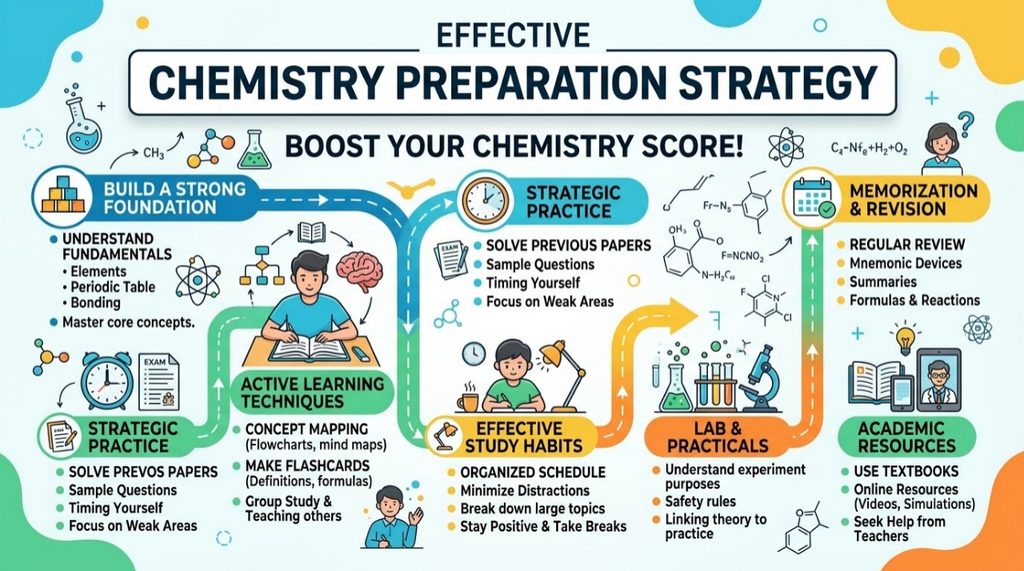
Chemistry requires a balanced approach.
Some areas require conceptual understanding, while others require careful memorization.
Students should avoid trying to memorize the entire textbook mechanically.
Instead, divide Chemistry preparation into manageable areas.
For each chapter:
- Understand the main concepts.
- Learn important reactions.
- Understand the conditions of reactions.
- Practice numerical problems where applicable.
- Review important facts.
- Solve relevant admission questions.
Create Short Revision Notes
Your revision notes should be short enough to review quickly.
For example, instead of rewriting an entire chapter, create a one-page summary containing:
- Important reactions
- Important rules
- Key concepts
- Exceptions
- Frequently confused topics
This becomes extremely useful before an examination.
English Preparation for Engineering Admission
Although Mathematics, Physics and Chemistry usually receive major attention from science students, English should not automatically be ignored.
Depending on the institution and admission system, English may be included in the admission process.
Students can improve their English preparation through regular practice in:
- Vocabulary
- Grammar
- Sentence structure
- Synonyms and antonyms
- Reading comprehension
- Common grammatical errors
You do not need to spend several hours every day on English.
Consistent short practice is usually more manageable.
For example, spending 20–30 minutes regularly can be more useful than studying English for several hours once a week.
How to Use Previous Engineering Admission Questions
Previous questions are extremely valuable because they help you understand the style and difficulty of an admission test.
But simply reading previous questions is not enough.
Use them actively.
First, solve the questions without looking at the answers.
Then check your performance.
Mark each question as:
- Correct and confident
- Correct but slow
- Incorrect because of concept
- Incorrect because of calculation
- Could not solve
This classification helps you identify your weak areas.
Create a Mistake Notebook
A mistake notebook can become one of your most useful preparation tools.
Whenever you make an important mistake, write down:
Question → Mistake → Correct Method → Lesson
For example:
Mistake: Used the wrong trigonometric identity.
Lesson: Review the identity before attempting similar problems.
Over time, you will notice patterns in your mistakes.
How Many Hours Should You Study Every Day?
There is no universal number of hours that guarantees success.
One student may make excellent progress in six focused hours, while another may spend ten hours studying with frequent distractions.
Instead of focusing only on total hours, focus on effective study time.
A productive study session may look like:
- 60–90 minutes focused study
- Short break
- Problem-solving session
- Short revision
- Another focused session
Avoid studying continuously for several hours without breaks if your concentration has already declined.
Quality Over Quantity
Studying for 10 hours does not automatically mean studying effectively.
A better goal is:
Understand → Practice → Review → Test → Correct
Repeat this cycle regularly.
Create a Weekly Study Plan
A weekly plan can prevent students from spending too much time on one subject.
For example:
| Day | Main Focus |
|---|---|
| Saturday | Mathematics + Physics |
| Sunday | Chemistry + Mathematics |
| Monday | Physics + English |
| Tuesday | Mathematics + Chemistry |
| Wednesday | Physics + Mathematics |
| Thursday | Chemistry + Revision |
| Friday | Mock Test + Error Analysis |
This is only an example. Your actual schedule should depend on your academic workload and individual weaknesses.
Use a Priority System
Divide topics into three categories:
A — Strong
You understand the topic and can solve questions quickly.
B — Moderate
You understand the basics but make occasional mistakes.
C — Weak
You struggle to understand or solve questions.
Spend the most time on Category C.
However, do not completely ignore Category A topics because regular revision is still necessary.
How to Prepare for Admission Tests Under Time Pressure
Time pressure is one of the biggest differences between normal academic examinations and competitive admission tests.
You may know the material but still lose marks because you spend too long on difficult questions.
Practice solving questions with a timer.
Initially, focus on accuracy.
Later, gradually introduce time limits.
For example:
Stage 1: Solve without time pressure.
Stage 2: Solve with a generous time limit.
Stage 3: Solve under realistic examination conditions.
Stage 4: Analyze your performance.
This approach can gradually improve both speed and confidence.
Should You Guess an Answer?
Whether guessing is beneficial depends on the examination’s marking rules.
Some admission tests may have negative marking, while others may use different scoring systems.
Therefore, never develop a guessing strategy without first checking the official examination rules.
If negative marking applies, random guessing can reduce your score.
Always read the current admission instructions carefully before the examination.
How to Choose an Engineering University
Preparing for admission is only one part of the process.
Students should also research the institutions and programs they are interested in.
Consider factors such as:
- Department quality
- Curriculum
- Laboratory facilities
- Research opportunities
- Faculty
- Campus environment
- Location
- Accommodation
- Tuition and other costs
- Internship opportunities
- Career prospects
Do not select a university only because it is popular among friends.
Different students have different academic and career goals.
Common Engineering Fields in Bangladesh
Engineering is a broad field.
Some popular disciplines include:
Computer Science and Engineering
CSE is popular among students interested in software, programming, artificial intelligence, data science, cybersecurity and technology.
Electrical and Electronic Engineering
EEE covers electricity, electronics, communication systems, control systems and related technologies.
Civil Engineering
Civil engineering focuses on infrastructure such as buildings, roads, bridges, water systems and transportation.
Mechanical Engineering
Mechanical engineering involves machines, manufacturing, thermodynamics, mechanics and mechanical systems.
Architecture
Architecture combines design, engineering principles, planning and creativity.
Students should research the actual curriculum and career paths before selecting a department.
Should You Join a Coaching Center?
A coaching center can be useful for some students, but it is not automatically necessary for everyone.
Coaching may provide:
- Structured classes
- Regular examinations
- Competitive practice
- Shortcuts and problem-solving techniques
- Peer learning
However, self-study can also be highly effective when a student has discipline and access to good academic resources.
The most important factor is not the name of the coaching center.
It is whether the student is actually learning and practicing consistently.
How to Avoid Burnout During Admission Preparation
Admission preparation can become mentally exhausting, particularly when students compare themselves with others.
Avoid measuring your progress against another student’s daily study hours.
Instead, compare your current performance with your previous performance.
If you scored 55% in a practice test last month and 70% today, that is meaningful progress.
Take reasonable breaks, maintain sleep, eat properly and avoid studying through severe exhaustion.
A tired mind is not always a productive mind.
The Importance of Sleep
Students sometimes reduce their sleeping hours before an important examination because they believe more study time will improve their results.
In reality, sleep is important for concentration, memory and mental performance.
Instead of sacrificing sleep regularly, build a sustainable routine.
A well-rested student may solve problems more accurately and make fewer careless mistakes.
One Month Before the Admission Test
When the examination is approaching, your strategy should gradually change.
You should spend less time learning completely new material and more time on:
- Revision
- Previous questions
- Mock tests
- Weak chapters
- Formula review
- Error correction
- Time management
Avoid constantly switching between new resources.
Use the materials you already understand and focus on improving performance.
One Week Before the Examination
The final week should be about consolidation rather than panic.
Review important formulas, concepts and mistakes.
Take realistic mock tests, but do not spend every waking hour solving questions.
Make sure you know:
- Examination location
- Reporting requirements
- Necessary documents
- Permitted materials
- Examination rules
- Time and date
Always verify these details from the official admission authority because they can change.
The Day Before the Admission Test
Do not attempt to learn an entire new subject the night before the examination.
Instead:
- Review important notes
- Check your documents
- Prepare necessary items
- Confirm the examination location
- Get enough sleep
- Avoid unnecessary stress
Your goal is to arrive at the examination with a clear and rested mind.
What to Do During the Admission Test
Read the instructions carefully before starting.
If the test allows you to skip questions, do not become emotionally attached to one difficult problem.
A useful approach is:
Easy questions → Moderate questions → Difficult questions
Answer questions you are confident about first.
Then return to questions that require more thought.
Keep an eye on the clock, but do not constantly check it every few seconds.
Common Mistakes Students Make
1. Studying Without a Plan
Randomly studying different chapters can create gaps in preparation.
2. Ignoring Weak Subjects
Students often study subjects they already enjoy while avoiding difficult chapters.
3. Memorizing Without Understanding
Memorization alone may not work when questions are presented differently.
4. Solving Questions Without Reviewing Mistakes
Practice only becomes powerful when mistakes are analyzed.
5. Using Too Many Books
More books do not necessarily mean better preparation.
6. Ignoring Previous Questions
Previous questions can reveal important patterns and help develop exam familiarity.
7. Sacrificing Sleep
Long study hours with inadequate rest can reduce concentration.
8. Comparing Yourself Constantly
Competition should motivate you, not destroy your confidence.
A Simple Engineering Admission Preparation Formula
A practical preparation cycle can be summarized as:
Learn → Practice → Test → Analyze → Revise
Learn
Understand the concept.
Practice
Solve different types of questions.
Test
Take a timed examination.
Analyze
Find out why you lost marks.
Revise
Review your weak areas and repeat the process.
This cycle is more effective than repeatedly reading the same chapter without testing yourself.
Final Advice for Engineering Admission Candidates
Engineering admission preparation is a long-term process.
You do not need to be perfect from the first day.
What matters is consistent improvement.
Build your fundamentals first. Practice Mathematics regularly. Understand Physics rather than memorizing formulas blindly. Review Chemistry systematically. Do not completely ignore English if it is part of your target admission test.
Most importantly, learn from your mistakes.
If you perform poorly in one mock test, treat it as information rather than a final judgment about your ability.
Your goal is not to prove that you already know everything.
Your goal is to identify what you do not know and improve it before the actual examination.
For Bangladeshi students, engineering admission can be highly competitive, but a structured preparation strategy can make the process much more manageable.
Start early, study consistently, practice under time limits, analyze your mistakes, and always verify current admission requirements from the official university or admission authority.
A good admission result is rarely the result of one extraordinary day. It is usually the result of many ordinary days of focused preparation.